
How a sixth-grade math teacher used OKO to transform student participation and confidence at Westlake Charter School, Sacramento, CA




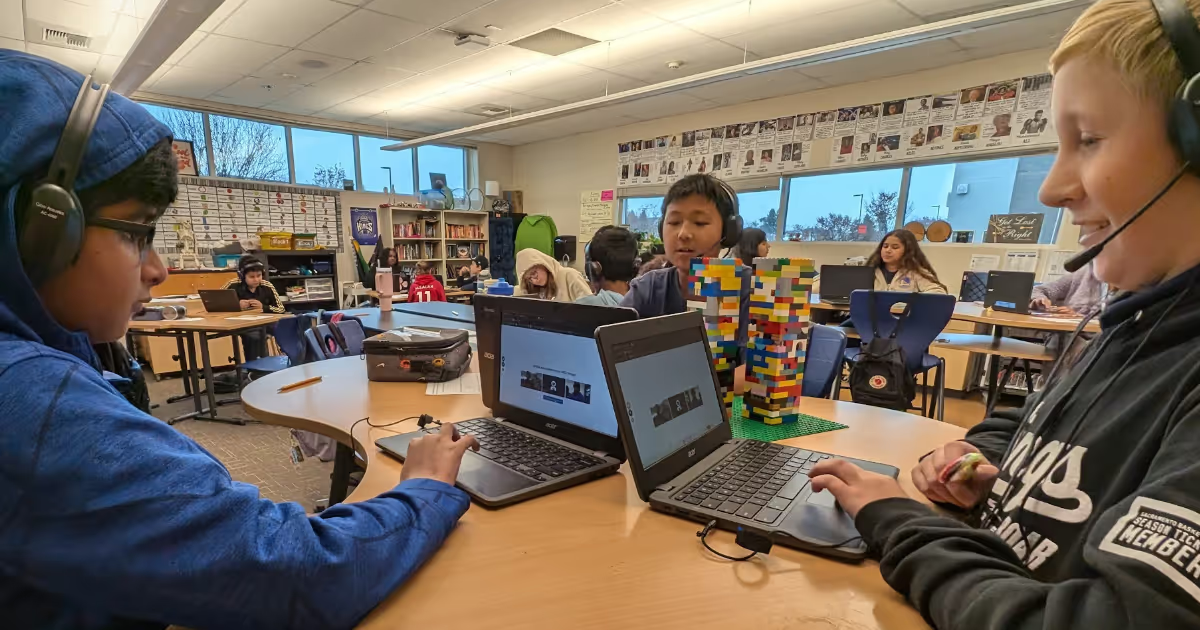
Westlake Charter School is a K–12 charter school in Sacramento, California. In its sixth-grade math classroom, teacher Sally Hubbard — a 25-year veteran educator — had begun to notice a troubling shift in student engagement.
While students were completing assignments and participating in lessons, their willingness to talk about math and their confidence in doing so was fading. Math scores had started to dip, and classroom conversations often stalled just when deeper reasoning was needed most.
Within this context, Sally began asking a different question: what would it look like if students had more structured opportunities to reason through math together?
Location: Sacramento, California
School: Westlake Charter School
Grades: K-12
Focus Grade: 6th Grade Math
Teacher: Sally Hubbard (25 years experience)
Subject: Math & Science
Cohort: Silicon Schools–funded study
Like many middle school classrooms, Sally's students varied widely in confidence and readiness. Some were eager to share ideas, while others stayed quiet — especially when unsure. Traditional small-group instruction helped, but sustaining meaningful discourse across multiple groups simultaneously was difficult.
Students often treated math as something to complete rather than something to discuss. When answers differed, conversations ended quickly instead of evolving into reasoning, justification, or collaboration. Over time, this lack of discourse began to show up in both engagement and performance.
"Students' willingness to talk about math — and confidence in doing so — was fading. Classroom conversations often stalled just when deeper reasoning was needed most."
Sally was introduced to OKO through a Silicon Schools–funded cohort study examining emerging AI tools in education. Unlike many AI programs designed for isolated, one-to-one practice, OKO stood out as a social and collaborative tool.
Students moved between independent thinking and team discussion, with OKO prompting individuals by name to ensure all voices were heard. When answers differed, students were guided to negotiate, explain, and reach consensus together.
— S. Hubbard, 6th Grade Teacher
OKO was embedded into Sally's existing math block. Groups of 3–5 students rotated through ~10-minute sessions while Sally worked with another small group or observed independently. 3–4 groups ran at a time.
The platform allowed Sally to assign below-grade content for foundational support, on-grade content for practice and reinforcement, and above-grade content for challenge and extension.
The shift in classroom culture was noticeable. Students who had previously stayed quiet were more willing to participate. The environment felt low-stakes, scaffolded, and positive — a sharp contrast to the anxiety that often surrounds middle school math.
Sally observed that struggle became normalized, and the tool created space for students to think, talk, and learn together — not because it taught math for her, but because it facilitated genuine mathematical conversation.
Students engaged more willingly, even when unsure about the material
Mistakes became part of learning rather than something to avoid
Students supported one another through peer explanation and collaboration
Students started asking for OKO time — a sign of genuine engagement
"OKO was a game changer — it helped students talk through math together, even when I couldn't be with every group."
— S. Hubbard, Sixth-Grade Math & Science Teacher
To deepen the impact, Sally paired OKO with explicit instruction aligned to Speaking & Listening Standard 1. She created a reference table of sentence stems to help students build on classmates' ideas, ask clarifying questions, and disagree respectfully using evidence.
Over time, students began using domain-specific math language more naturally and confidently. They weren't just solving problems — they were learning how to talk about math.
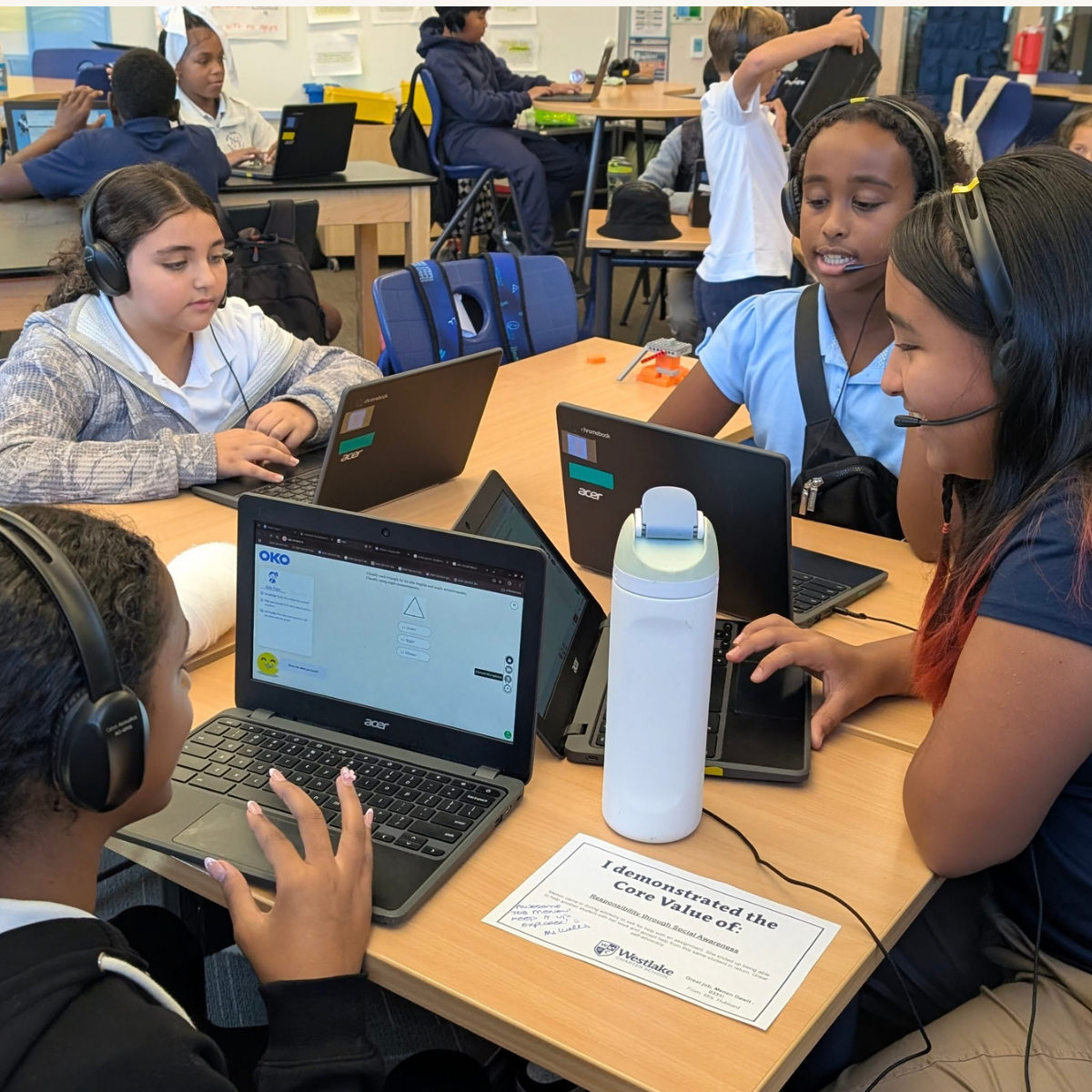
Perhaps most telling, students started asking for OKO time.
Sally created a reference table of sentence stems aligned to Speaking & Listening Standard 1 to scaffold productive discourse:
→ Build on classmates' ideas
→ Ask clarifying questions
→ Disagree respectfully using evidence
Rather than replacing instruction, OKO was designed to facilitate student-to-student mathematical conversation, prompting learners to explain reasoning, respond to peers, and work toward shared understanding.
OKO aligned with Sally's core belief: that learning happens best when students reason together.
Small groups of 3–5 students supported real conversation and ensured every voice could be heard during discourse sessions.
AI facilitation ensured equitable participation by calling on students by name, even without constant teacher presence in the group.
Short sessions fit naturally into existing classroom routines without adding instructional burden or complexity.
Explicit discussion norms and sentence stems helped students engage productively and build on each other's mathematical reasoning.
Many schools face the same challenge Sally identified — students who can complete work but struggle to articulate understanding. This case demonstrates that AI-facilitated discourse, when thoughtfully integrated, can:
→ Build on classmates' ideas
→ Support collaborative learning
→ Reduce instructional strain on teachers
Rather than isolating students, OKO helped reconnect them — to each other, to mathematical thinking, and to the learning process itself.

