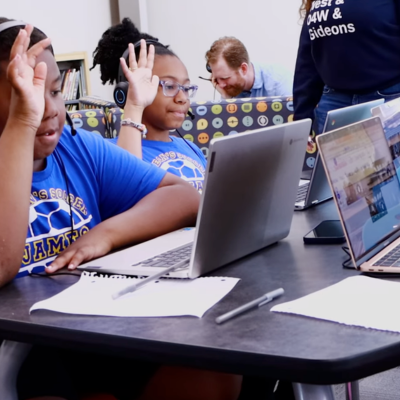
Small-group instruction works when a teacher is at the table, and one teacher can only cover one table at a time. OKO facilitates the other groups, so students reason out loud together while the teacher works the one that needs them.


Guided math, math workshop, Building Thinking Classrooms, MTSS, and WIN-time blocks all put students in small groups. They work when a teacher is at the table. The problem is the other four or five groups.
While a teacher works one group, the rest run unsupervised. Most math intervention programs answer this by putting each student alone on a screen.

OKO does the opposite, facilitating the groups the teacher isn't with, on work matched to each group's level.
Students struggling in math, quieter students, and multilingual learners often stay on the edge.

OKO draws students into the group by name, and teachers report the biggest jump in participation from exactly these students: those struggling in math, quieter students, and multilingual learners.
Small-group time can be hard for leaders to see.

OKO gives you a read on what happened in every group, not just the one the teacher worked with.
OKO also fits how you already work. It aligns to the curriculum you've adopted (Illustrative Mathematics, Eureka, and any other scope and sequence you share) and needs no rostering or student accounts, since students join with a group code. It works as a supplemental math program alongside your core curriculum, a second pair of hands rather than a replacement for a teacher or an interventionist.
How OKO handles AI, screen time, and data
Students talk to each other. There is no private one-to-one chat between a student and a model anywhere in the product.
The math is worked on paper and whiteboards. OKO shows the problem and facilitates the group's conversation.
Recommended dose: 30 to 45 minutes per student per week, in two or three short sessions. OKO tracks it and reports it back to your school.
OKO is FERPA and COPPA compliant in all fifty states. It keeps no raw audio or video, de-identifies data before it reaches any model, and AI providers can't train on it. It has cleared the NYC DOE ERMA review.
Where a district has screen-time policies, OKO is the kind of use they're meant to preserve. Students talk to each other, with the math on paper. For the full picture, see how OKO approaches AI and screen time.
OKO is an evidence-based math intervention program, and the core research behind it was designed and run by WestEd, independently of OKO.
A randomized controlled trial designed and run by WestEd in Hamilton County Schools, a public district in Tennessee.
WestEd built the study, collected the data, and ran the analysis on their own.
WestEd's observers watched OKO students explain their thinking and correct each other's mistakes on hard problems.
In comparison classrooms, students rarely talked about the math.
Teachers in the trial reported getting back about 2.8 hours a week.
An earlier peer-reviewed WestEd study found statistically significant math gains and a measurable drop in math anxiety.

OKO runs inside familiar structures like WIN time, Tier 2 and Tier 3 intervention blocks, response to intervention (RTI), and station rotation inside core instruction.
Same footprint, now facilitated and measured.
It also produces the discourse NCTM's 5 Practices are built to orchestrate. Standard for Mathematical Practice 3 asks students to construct and critique each other's arguments. That's the reasoning OKO produces.
It shows every group's progress live during a session and flags the ones that need the teacher, whether answers are going wrong or a conversation has stalled. The teacher can step into any group already knowing where it stands.
School and district reports roll up usage by teacher, the standards each group is working on, collaboration trends, and proficiency by standard, so you can see whether OKO is being used and whether it's driving student outcomes.
Onboarding and professional development come with the license, run by OKO's partner success team.
Weekly usage is tracked and reported back to school leaders, so implementation is visible from week one.
Start with a small pilot (two teachers, eight weeks) or roll out at scale. Jen Lougheed, Director of Partner Success, is your named contact.
Most schools fund OKO from budgets they already have, like Title I schoolwide, Title IV, 21st Century Community Learning Centers, and technology or professional development lines. Title I schools receive an automatic discount. We'll help you find the right line, and scope a pilot or a full rollout to fit it.
"The true collaboration came in the work. I am sold, I really do love this program."
— Jordan Wise, 5th-grade math, KIPP