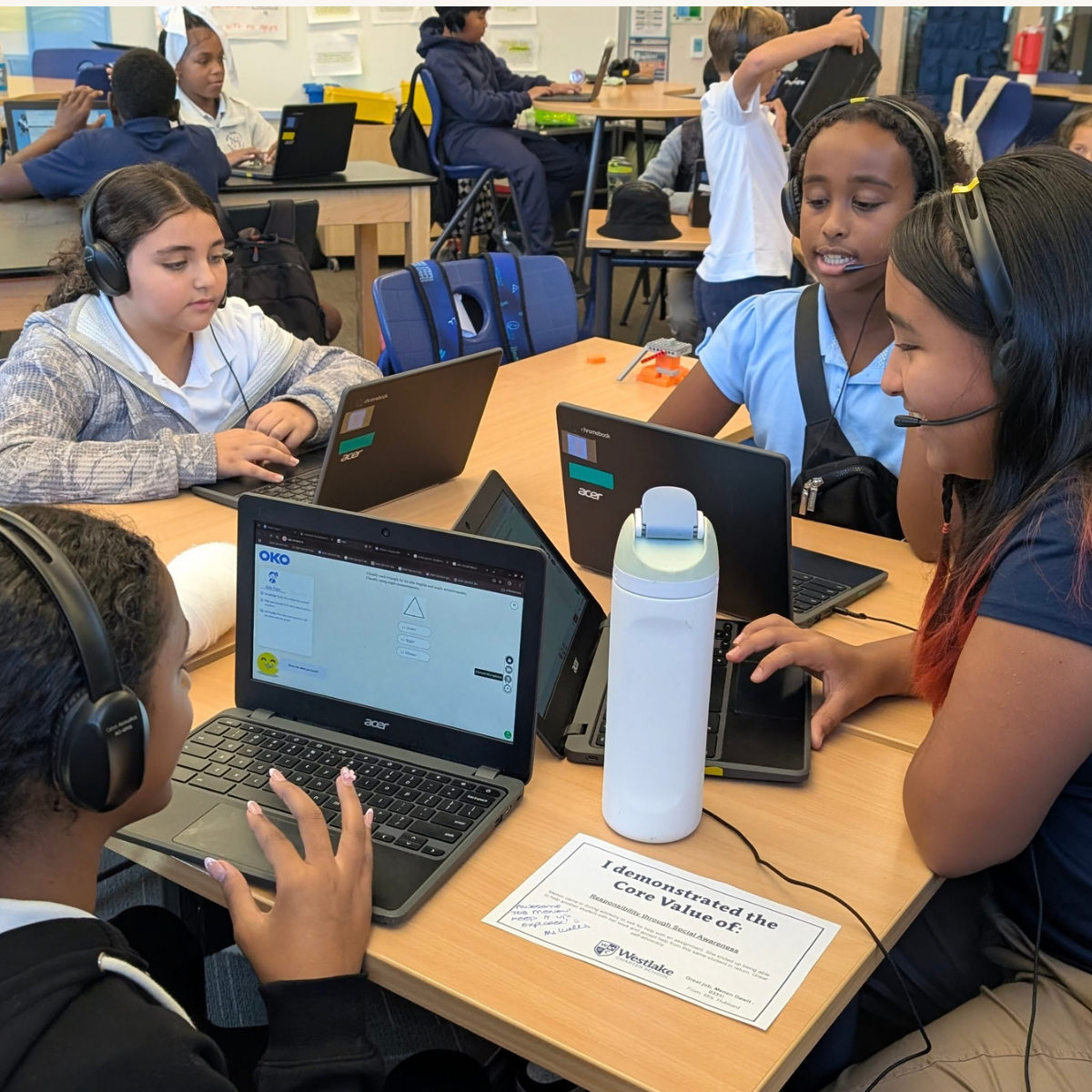
Small-group instruction is a powerful tool, but it's impossible to be at every table at once. OKO supports the groups you aren't sitting with, keeping students reasoning out loud on problems matched to each group's level and aligned to your curriculum, so you can put your attention where it's needed most.
Whether you run guided math, a math workshop, a Building Thinking Classrooms setup, or math stations, OKO facilitates all your groups at once, keeping two to five students reasoning out loud about the math. You move around the room with a live view of every group.
After each session, OKO shows you how each group did on the math and where they got stuck. Use those insights to plan your next lesson.
Filter by standard, learning component, and question type, and pick the exact questions a group works on. It aligns to Illustrative Mathematics at the lesson level, to Eureka at the scope-and-sequence level, and to other scopes and sequences on request.
OKO is a second pair of hands, not a replacement for you. You lead the room; OKO covers the tables you can't reach.
You're at the back table with the group that needs you. Across the room, a group works a problem set with OKO between them, talking it through together.
OKO listens and steps in: it asks the student racing ahead to explain, or draws in the one who hasn't said much. No hint until the group is actually stuck.
The math stays on paper. When the session ends, you get a read on every group you weren't working with: the math, the collaboration, and the moments that moved them along.
OKO is not an AI tutor. Here's what a session really is.
Students talk to each other. There is no private one-to-one chat between a student and a model anywhere in the product.
The math is worked on paper and whiteboards. The screen holds the problem and the group's conversation.
Recommended dose: 30 to 45 minutes per student per week, in two or three short sessions. OKO tracks it and reports it back to your school.
OKO isn't built for students below grade 3.
If your school is rethinking screen time, OKO is the kind of use those policies are meant to protect: students talking to each other, with the math on paper. Read how OKO approaches AI and screen time in the classroom.
The research below was designed and run by WestEd, independently of OKO.
A randomized controlled trial designed and run by WestEd in Hamilton County Schools, a public district in Tennessee.
WestEd built the study, collected the data, and ran the analysis on their own.
WestEd's observers watched OKO students explain their thinking and correct each other's mistakes on hard problems.
In comparison classrooms, students rarely talked about the math.
Teachers in the trial reported getting back about 2.8 hours a week.
An earlier peer-reviewed WestEd study found a measurable reduction in students' math anxiety. ESSA Tier III and IV (LeanLab).


Grounded in the research.
OKO builds on the methods strong math teachers already use: the NCTM 5 Practices for running a discussion, and students who construct and critique each other's reasoning. The scoring behind it draws on established research on collaborative learning, from Cohen and Lotan to CASEL.
No rostering to set up. Students join their group with a code, so your first session doesn't wait on IT.
Onboarding and PD are included. Professional development comes with the license, and OKO's team runs it with you.
Decide where it fits. The main thing to decide is where small-group math instruction with OKO fits in your week.
"The true collaboration came in the work. I am sold, I really do love this program."
— Jordan Wise, 5th-grade math, KIPP